Your catalogue, finally complete.
The Enrichment PIM turns thin, inconsistent product data into accurate, on-brand content, written by AI, checked by your team and published to HDL Commerce.
Every catalogue has the same quiet problem
Picture a Monday at Acme Outdoor. Three hundred new jackets and tents arrived from suppliers over the weekend. Some have a name and a price. Some have a supplier description written for another market. Half are missing a weight, a material or a waterproof rating. The Finnish texts are copies of the Swedish ones.
None of this is anyone's fault. It is simply what happens when product data comes from many places and the team that owns it is small. So the work waits. Products go live half finished, or they do not go live at all.
And every gap costs something. A missing size chart becomes a return. A vague description becomes a lost sale. A wrong specification becomes a complaint. Multiply that by thousands of products, several languages and several channels, and the catalogue stops being an asset and starts being a backlog.
AI can write. That was never the hard part.
Generating text is easy now. The hard part is trusting it.
A generic AI writer will happily invent a waterproof rating that sounds right. It will overwrite the description your team polished by hand. It writes in a voice that is not yours. And once it has written, nobody can tell you where the facts came from.
That is why most teams either avoid AI for product data or spend as long checking its output as they would have spent writing it.
The Enrichment PIM was built to remove that trade-off.
How it works
A different way to work: AI proposes, your team decides
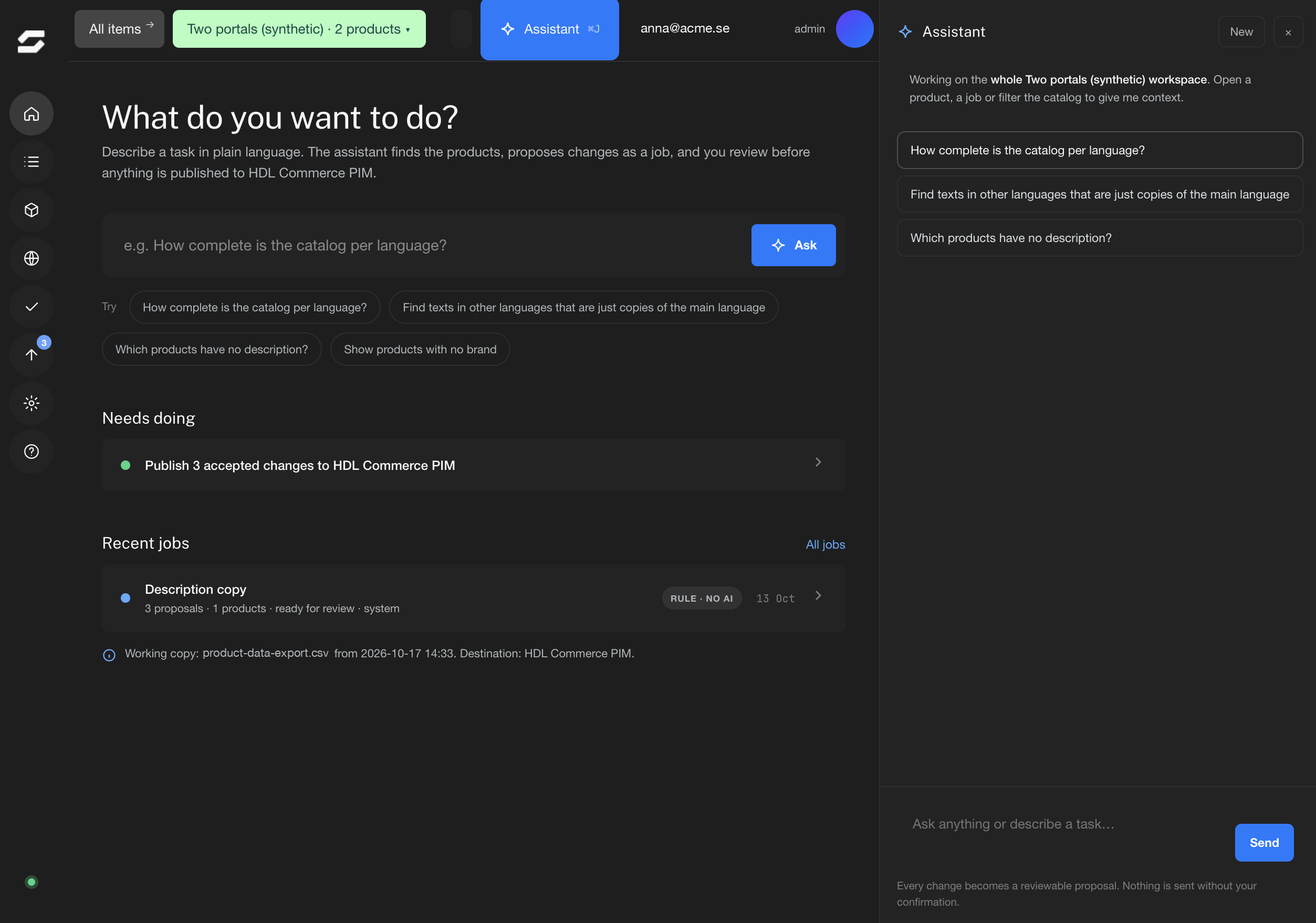
Back to Monday at Acme Outdoor. This time, the catalogue manager types one sentence:
“Write descriptions for every new jacket without one, and find the missing weights.”
Here is what happens next.
It reads each product, follows your brand voice and writing guidelines, and looks up missing facts in the sources you trust: supplier files, manufacturer pages, and, if you allow it, the web.
Nothing is written into your catalogue. Each proposal shows the old value, the new one, and the source behind it. Facts without a source are flagged. Values your team edited by hand are never touched.
Scan the list, accept what is right, adjust what needs a human touch, reject the rest. One at a time or hundreds at once.
Published through the enrichment API, with a full record of what was sent and when. Changed your mind? Undo is built in.
By lunch, three hundred products are complete, consistent and in your voice. And everything that went live was checked by a person.
What it gives you
The repetitive part of catalogue work, writing, translating and looking things up, is done for you. Your team spends its time on judgement, not typing.
Complete, specific, well-written product pages answer the customer's question before they ask it. Fewer abandoned carts, fewer returns, better search visibility.
Your brand voice and guidelines apply to every product and every language, so the catalogue reads like one company wrote it.
Every value has a source you can see. Every change has a name behind it. Nothing reaches your customers without a person saying yes.
New ranges go live when they arrive, not when the team catches up.
Why it is different
-
01 AI with guardrails, not AI on autopilot.
Most tools either keep AI out of product data or let it write freely. The Enrichment PIM sits in between: the AI does the work, your rules set the limits, and your team has the final word. Fill-only by default, manual edits protected, facts flagged without evidence.
-
02 Evidence, not guesswork.
Every proposed fact can show where it came from: a supplier file, a manufacturer page, a web result. Your reviewers see the source next to the value, so checking takes seconds.
-
03 Your expertise, saved as rules.
The way your company writes and the rules your products follow are stored as guidelines, saved instructions and Enrichment Skills. Set them once, and every product, every language and every new team member benefits from them.
-
04 Set up by conversation.
Say “Let's set up”. The assistant asks about your company, your markets and your tone, studies your products and proposes your whole setup in one review: brand voice, guidelines, languages and rules. No consultants, no weeks of configuration.
-
05 Open to every AI tool you use.
Every action in the Enrichment PIM is also an API call, and the PIM speaks MCP, the standard way AI assistants connect to business systems. Your team can work with the catalogue from Claude or their own AI tools, under the same rules and the same reviews.
-
06 Built native to HDL Commerce.
It is not a plugin bolted onto your store. It reads your HDL Commerce attribute sets, languages and channels, and publishes straight into the HDL Commerce PIM. Your data model is the PIM's data model.
Why no one else does this
Traditional PIM systems are excellent at storing product data and poor at creating it. They give you fields to fill, not content.
AI writing tools are fast at creating content and careless with facts. They give you text, not trust.
The Enrichment PIM is built on the belief that you should not have to choose. It combines the discipline of a PIM, with structure, validation, review and history, with the speed of AI, and adds what neither has on its own: evidence for every fact, and a human decision before anything goes live.
Natively integrated with HDL Commerce
The Enrichment PIM is made for HDL Commerce. Your attribute sets, languages and channels come straight from HDL Commerce, and accepted changes are published back into the HDL Commerce PIM through the enrichment API. Two-way sync, pulling product updates from HDL Commerce as they happen, is on the way.
Built to support WooCommerce, Shopify and Magento
Underneath, the Enrichment PIM is platform-neutral. HDL Commerce is its native home, and every store connection goes through the same connector interface. Connectors for WooCommerce, Shopify and Magento fit that interface without changes to the core, your rules or your workflows. Talk to us about connecting your platform.
Built for businesses that take their data seriously
- Every proposal, every decision and every publish is recorded, with the name behind it.
- Nothing is published to your catalogue without a person on your team accepting it.
- Your product data is never used to train AI models.
- Processed under our Data Processing Addendum, with EU/EEA hosting and a published sub-processor register.
Questions we hear
Will the AI change things on its own?+
No. Every change is a proposal. Nothing is published until a person on your team accepts it.
What happens to texts we wrote ourselves?+
They are protected. The AI fills gaps; it does not overwrite your team’s work unless you explicitly ask it to.
Can it write in our languages?+
Yes. It writes each language for its own market, following your guidelines, not as a word-for-word translation.
How long does it take to get started?+
For HDL Commerce customers, the setup is a short conversation with the assistant and a review of what it proposes.
Be among the first
The Enrichment PIM is now open to a small group of HDL Commerce customers in a pilot programme. Pilot customers work directly with the team that builds it and shape what comes next.